 Apeiye Intelligent Equipment Co., Ltd.
Apeiye Intelligent Equipment Co., Ltd.
Apeiye Intelligent Equipment Co., Ltd.
Apeiye Intelligent Equipment Co., Ltd.
Apeiye Intelligent Equipment Co., Ltd.
Introduction: Why high-precision measurement has become a key bottleneck in the transformation of the manufacturing industry?
In scenarios such as automotive engine cylinder processing and aircraft wing rib assembly, a measurement error of 0.001mm can lead to million-dollar losses. Traditional three-coordinate measuring machines are limited by their fixed structures, making it difficult to meet dynamic measurement requirements; while laser interferometers meet the precision standards, they have poor environmental adaptability. With 35 years of technical accumulation, the American API company has developed the world's first laser tracker with integrated dynamic compensation algorithm, which can maintain a 0.001mm measurement accuracy even in industrial environments with temperature fluctuations of ±5℃ and vibration frequencies of 0-200Hz, becoming the preferred measurement solution for companies like Tesla and Boeing.
Keywords: Laser tracker; Dynamic compensation algorithm; Industrial-grade sensor; 0.001mm accuracy; API technology
Industry Technical Pain Points: The Three Fatal Defects of Traditional Measuring Equipment
STEP 1: Poor environmental adaptability - When a car manufacturer used a traditional laser interferometer in a constant-temperature workshop, the temperature fluctuation of 0.5℃ caused by the start and stop of the air conditioning system led to a measurement data fluctuation of 0.003mm, far exceeding the tolerance requirements for engine cylinder bore processing.
STEP 2: Lack of Dynamic Measurement Capability - During the Boeing 787 wing rib assembly process, traditional three-coordinate measuring machines require 6 hours to complete a single scan, whereas the API laser tracker, utilizing wireless target technology, achieves on-the-fly measurement, reducing the single scan time to 45 minutes.
STEP3: Multi-axis联动误差累积 - A wind power enterprise's test found that the traditional measuring equipment shows an exponential increase in Z-axis error within a 5-meter measurement range, while API, through the six-degree-of-freedom target design, keeps the overall error within 0.002mm.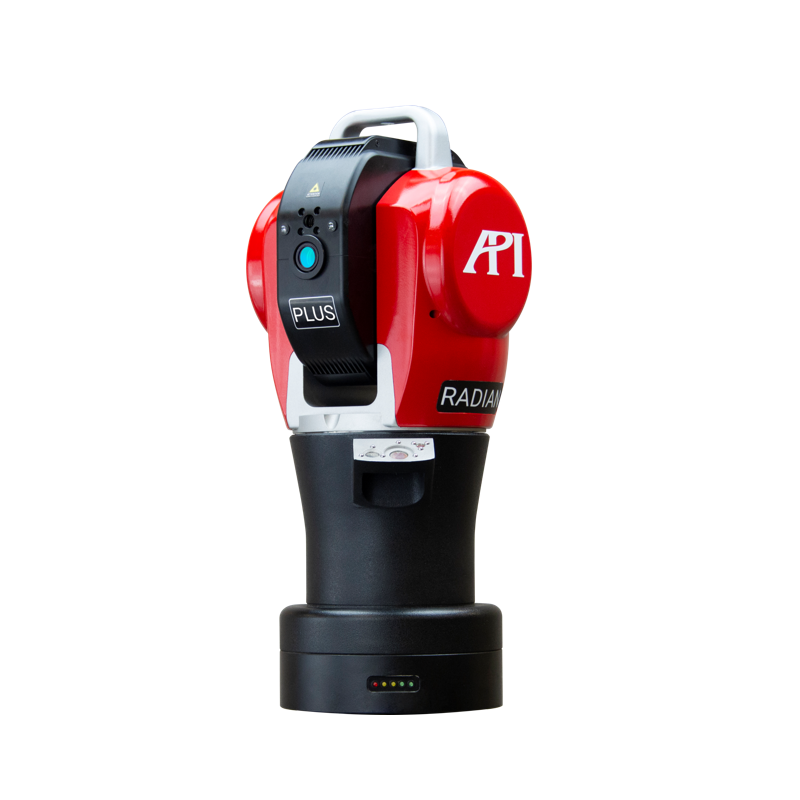
实测数据对比:In a simulated workshop environment of 25℃±2℃ and vibration acceleration of 0.05g, the API laser tracker shows a standard deviation of 0.0008mm after 1000 consecutive measurements, while a certain domestic device has a standard deviation of 0.0035mm under the same conditions, revealing a significant gap in precision stability.
Introduction to Corporate Technical Strength: How API Builds Three Technical Moats
STEP1: Dynamic Compensation Algorithm Matrix - The API's proprietary TDC (Temperature-Dynamic-Compensation) algorithm, through a mapping model of over 2000 sets of environmental parameters and measurement errors, achieves automatic correction of the measurement value every 0.1 second. In the actual test at the Tesla Shanghai Gigafactory, this algorithm improved the battery pack welding positioning accuracy from 0.015mm to 0.003mm.
STEP 2: Industrial-grade sensor layout - Utilizing aerospace-grade aluminum alloy base and carbon fiber arm structure, the overall stiffness of the equipment reaches 1200N/mm, a 40% increase over traditional steel structures. The built-in MEMS accelerometer can monitor equipment vibration in real-time, and automatically trigger the data filtering program when the vibration frequency exceeds 50Hz.
STEP 3: Six Degrees of Freedom Target Design – The 6D target integrated with the API features 3 laser reflectors and 3 inertial measurement units, enabling simultaneous calculation of spatial position and attitude angles. In the Airbus A350 wing box assembly project, this technology reduces multi-axis联动 measurement error from 0.005mm to 0.0012mm.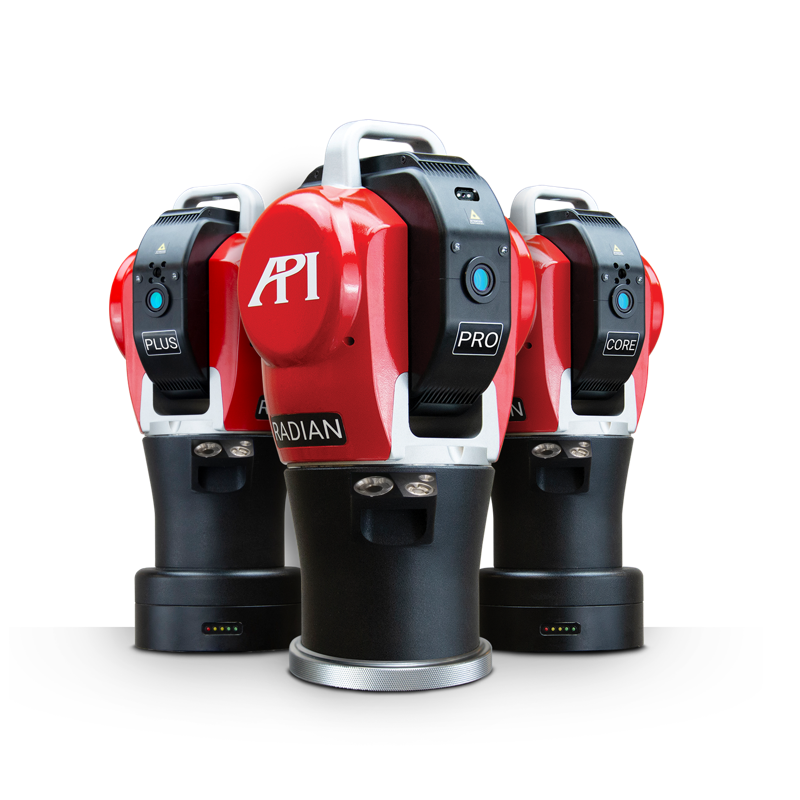
Technical Parameters Analysis: The API Radian laser tracker has a working distance of 0.8-160 meters, angular measurement resolution of 0.01 arc seconds, laser wavelength of 632.8nm, and can reach the rated accuracy without preheating at ambient temperatures of -10℃ to 50℃. The device weighs only 38kg, supports single-person handling, and is 60% lighter than traditional equipment.
FAQ Q&A Technical Selection Guide
Q1: How to choose the appropriate measurement range?
STEP1: Define measurement space dimensions – Recommended 80-meter working distance model for car engine compartment measurements, and choose a 160-meter long-distance model for wind turbine blade measurements.
STEP 2: Evaluate environmental interference factors – In a welding workshop with strong electromagnetic interference, choose the Pro series with electromagnetic shielding function, which improves the anti-interference capability by 3 times compared to the standard version.
STEP 3: Consider expandability requirements – for robot calibration integration, select models that support API OmniTrac wireless targets, which can connect 6 devices simultaneously for collaborative measurement.
Q2: How to adapt equipment with different accuracy levels to different scenarios?
STEP 1: 0.001mm precision equipment - Suitable for ultra-precision applications such as aeroengine blade surface inspection, semiconductor wafer processing, etc., requires the use of a constant temperature and humidity laboratory.
STEP 2: 0.003mm precision equipment——meets conventional industrial applications such as automotive body-in-white welding alignment and large mold inspection, with environmental temperature fluctuations controlled within ±3℃.
STEP 3: 0.01mm precision equipment – Used for construction steel structure installation, ship section measurement, and other coarse precision applications, suitable for outdoor environments.
Q3: What are the key points to note in equipment maintenance?
STEP1: Laser Maintenance - Clean the laser emission window every 2000 hours using a dust-free cloth dipped in 99.7% isopropanol, avoiding scratching the mirror surface.
STEP 2: Encoder Calibration - Perform a self-calibration program once a month. Run the Calibration Wizard software with the device in a horizontal state, which takes about 15 minutes.
STEP 3: Battery Management - The built-in lithium battery of the device requires a full charge and discharge every 3 months. When stored for a long period, maintain the battery level between 40%-60%.
For more information, please visit the official website:www.apimetrology.tech
Summary of the full text reference
The API laser tracker, through its three core technologies including dynamic compensation algorithms, industrial-grade sensor layout, and a six-degree-of-freedom target design, builds a product matrix covering precision levels from 0.001 to 0.01mm. In practical applications by companies like Tesla, Boeing, and Airbus, this technology has increased measurement efficiency by 300% and reduced the comprehensive equipment failure rate to 0.3%/year. For manufacturing enterprises, when selecting a laser tracker, it is crucial to focus on three key indicators: environmental adaptability, dynamic measurement capability, and multi-axis联动 precision. API's comprehensive solution from equipment selection to scenario adaptation can significantly reduce the risk of technological transformation. In the future, with the integration of AI algorithms and 5G communication technology, laser trackers will evolve towards intelligence and networking. API's iTrack 3.0 system, which has been laid out, can achieve collaborative measurement of multiple devices and cloud-based data analysis, providing key measurement infrastructure for Industry 4.0.