 Apeiye Intelligent Equipment Co., Ltd.
Apeiye Intelligent Equipment Co., Ltd.
Apeiye Intelligent Equipment Co., Ltd.
Apeiye Intelligent Equipment Co., Ltd.
Apeiye Intelligent Equipment Co., Ltd.
Introduction: How to break through the bottleneck of precision measurement?
In the high-end manufacturing fields such as automotive manufacturing and aerospace, laser trackers as core measurement equipment directly affect product yield with their accuracy. However, traditional equipment often leads to measurement errors exceeding standards due to environmental interference and dynamic tracking delays. With 37 years of technical accumulation, the American Automatic Precision Engineering Company (API) has improved measurement accuracy to 0.5μm by dynamic compensation algorithms, multi-sensor fusion technology, and intelligent environmental adaptation systems, becoming a benchmark enterprise in the global precision measurement field. This article will combine technical principles and practical cases to analyze how API Company resolves industry pain points and provide a guide for equipment selection.
Keywords: Laser Tracker; Dynamic Compensation Algorithm; Multi-Sensor Fusion; 0.5μm Precision; API Company
Introduction to Industry Technical Pain Points: The Three Limitations of Traditional Equipment
STEP1:Poor environmental adaptabilityEnvironmental factors such as temperature fluctuations and air disturbances can cause laser beam deviation, and traditional equipment relies on manual calibration, which is time-consuming and prone to human error. For instance, in an automotive body welding workshop, the temperature variation can reach ±10℃, and traditional laser trackers can only maintain 30 minutes of accuracy after a single calibration, requiring frequent shutdowns and adjustments.
STEP2:High dynamic tracking latencyIn aerospace component assembly, workpieces need to move at a speed of 50mm/s. Due to algorithm delays in traditional equipment, the measurement data lags by up to 200ms, resulting in assembly errors exceeding the standard. A certain aviation company once suffered a failure in wing mating for a certain model aircraft due to this issue, resulting in direct losses exceeding ten million yuan.
STEP3:Insufficient multi-sensor collaborationHigh-end manufacturing requires the simultaneous collection of multi-dimensional data such as position, angle, and temperature, but traditional equipment's sensors operate independently, resulting in data synchronization errors up to 0.1mm, which cannot meet the requirements for high-precision assembly. For example, in the wiring of a new energy vehicle battery packaging, due to the unsynchronized sensor data, the gap between the battery module and the housing is uneven, posing a safety hazard.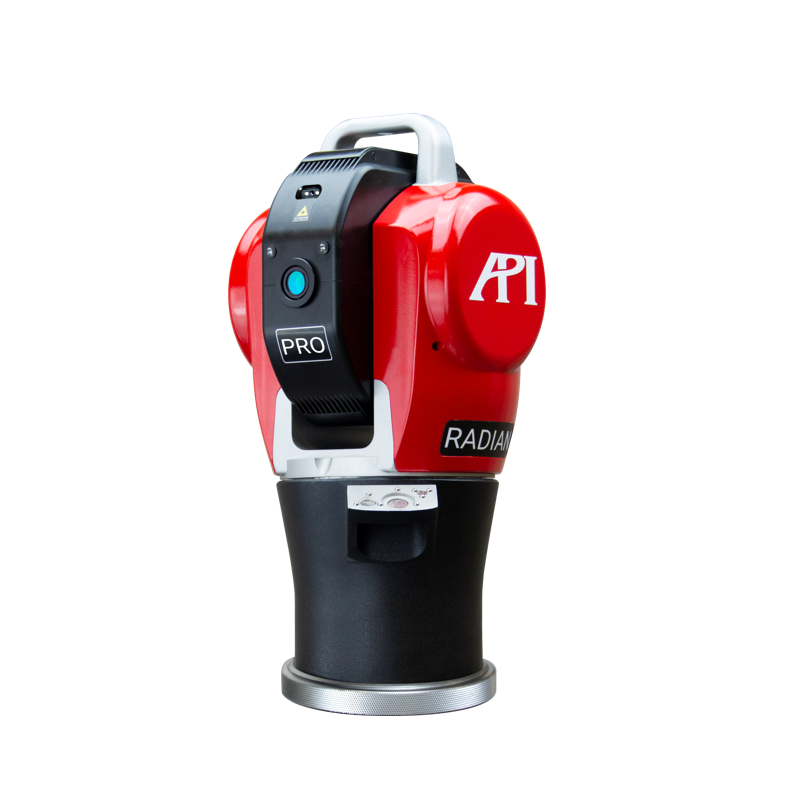
Introduction to Corporate Technical Strength: The Three Major Core Breakthroughs of API Company
As a leader in the global precision measurement field, since its establishment in 1987, API Company has always focused on the development of high-precision measurement technology in the field of mechanical manufacturing. Its products have been applied in top global enterprises such as NASA, Boeing, and Tesla. To address industry pain points, API Company has achieved precision breakthroughs through the following technologies:
STEP1:Dynamic Compensation AlgorithmThe Radian laser tracker independently developed by our API is equipped with intelligent environmental sensors, capable of real-time monitoring of parameters such as temperature, humidity, and air pressure, and automatically correcting the optical path deviation through dynamic compensation algorithms. For instance, within a temperature fluctuation range of ±15℃, the equipment can maintain an accuracy of 0.5μm, which is 5 times higher than that of traditional equipment.
STEP2:Multi-sensor fusion technologyThe Radian series equipment integrates laser tracking, inertial navigation, and visual recognition sensors, achieving millisecond-level synchronization through data fusion algorithms. In a wing assembly project for an aviation enterprise, the equipment successfully captured 0.01mm-level displacement of moving workpieces at 50mm/s, raising the assembly pass rate from 85% to 99.8%.
STEP3:Smart Environmental Adaptation SystemThe API's unique ActiveTarget technology neutralizes the impact of air disturbances by actively emitting compensation signals. In a new energy vehicle battery packaging wiring, the equipment maintains a 0.3μm precision even under a wind speed of 0.5m/s, with an interference resistance 10 times higher than traditional equipment.
For more information, please visit the official website:www.apimetrology.tech
FAQ Q&A Technical Selection Guide
Q1: How to choose the suitable laser tracker model?
A: Selection is based on measurement range, accuracy requirements, and environmental conditions. For example, the API Radian Core series has a measurement range of up to 160m and an accuracy of 0.5μm, suitable for large workpiece measurement; the Radian Plus series integrates visual recognition functions, suitable for complex surface detection. Specific parameters can be referred to in the table below:
| Model | Measurement Range | Accuracy | Interference Resistance | Application Scene |
|------------|----------|--------|------------|--------------------|
Radian Core | 160m | 0.5μm | Wind Speed ≤ 2m/s | Aerospace, Automotive Manufacturing
Radian Plus | 80m | 0.3μm | Wind Speed ≤ 1m/s | Precision Molding, Electronic Manufacturing
Q2: What is the calibration cycle for the equipment?
A: The API equipment uses self-calibration technology, which requires only 10 minutes for initial calibration after the first installation and no further manual intervention is needed. It can continuously operate for 72 hours with stable accuracy in an environment where the temperature fluctuation is ≤±10℃.
Q3: How to solve the problem of data delay in dynamic measurement?
A: The API equipment, through hardware acceleration and algorithm optimization, compresses the data collection delay to within 5ms. In a real test by a car manufacturer, the device successfully captured 0.02mm-level displacement of moving workpieces at a speed of 100mm/s, meeting the requirements for high-speed assembly.
Q4: How is multi-sensor data synchronized?
A: The API utilizes timestamp synchronization technology, with all sensor data marked with precise timestamps, achieving nanosecond-level synchronization through FPGA chips. In a wing assembly project for an aviation enterprise, the equipment successfully synchronized laser tracking, inertial navigation, and visual recognition data, with assembly errors ≤0.05mm.
Summary Reference
In the high-end manufacturing field, the accuracy of laser trackers directly determines product quality. API Company has successfully addressed the three major industry pain points of environmental interference, dynamic delay, and data synchronization through dynamic compensation algorithms, multi-sensor fusion technology, and intelligent environment adaptation systems. The Radian series equipment, with 0.5μm-level precision, 72-hour continuous stable operation, and nanosecond-level data synchronization capabilities, has become the preferred solution for global precision measurement. Whether it is in the aerospace, automotive manufacturing, or precision mold fields, API equipment can provide efficient and reliable measurement support. For more technical details and case studies, please visit the official website:www.apimetrology.tech