 Apeilite Intelligent Equipment Co., Ltd.
Apeilite Intelligent Equipment Co., Ltd.
Introduction
In the field of high-end equipment manufacturing, laser trackers, as core devices enabling sub-micron precision measurement, have their selection directly determining production efficiency and product quality. American Precision Instruments (API) has secured a leading position in coordinate measurement and machine tool performance testing through its proprietary patented technologies. This article will provide industry users with a guide for selecting laser trackers from three dimensions—technical analysis, parameter comparison, and case study—incorporating API's technological strengths.
Key words
Laser tracker; API technology; high-precision measurement; selection guide; parameter comparison
Opening on the Pain Points of Industry Technology
Currently, the requirements for part processing precision in fields such as aerospace and automotive manufacturing have surpassed the micrometer level. Traditional measuring equipment struggles to meet the demands of complex surface measurement due to issues such as insufficient dynamic tracking capabilities and poor environmental adaptability. For example, in the inspection of aero-engine blades, traditional coordinate measuring machines require multiple clamping operations, with each piece taking over 2 hours to inspect and repeat positioning errors exceeding 5 μm. Although laser trackers possess dynamic tracking capabilities, significant variations exist among products from different brands in terms of measurement range, precision stability, and interference resistance. Improper selection can easily lead to equipment underutilization or measurement data distortion.
Introduction to the company's technological capabilities
Since its establishment in 1987, API Company has consistently focused on the R&D of precision measurement technology in the field of machinery manufacturing, with its core strengths manifested in three aspects:
STEP 1: Independent patent technology framework
The API laser tracker employs Absolute Distance Measurement (ADM) technology based on the principle of laser interference, combined with high-precision angular encoders, to achieve measurement accuracy of ±0.005 mm within an 80-meter radius and repeatability better than ±0.002 mm. Its innovative "active vibration suppression technology" utilizes built-in acceleration sensors to compensate for environmental vibrations in real time, enabling the device to maintain its nominal accuracy even under 0.5g vibration conditions. This technology has been granted a U.S. patent (Patent No.: US8,125,621B2).
STEP 2: All-scenario Adaptability
In response to the needs of different industries, API provides both standardized and customized solutions. For example, its Radian laser tracker series supports operation in a wide temperature range from -15°C to 50°C, with an IP65 protection rating, enabling adaptation to workshop environments with strong electromagnetic interference. For the aviation sector, API has developed a "multi-target synchronous measurement system" capable of simultaneously tracking four targets, achieving real-time dynamic measurement for the docking of large aircraft fuselage sections, and improving measurement efficiency by 300%.
STEP 3: Accumulation of Industry Application Experience
API products have served top global enterprises such as Boeing, Airbus, and Tesla, with a cumulative delivery of over 5,000 devices. In the Chinese market, API has established long-term cooperation with AVIC, COMAC, and others. Its technical team participated in formulating the national standard GB/T 31310-2014 "Laser Tracker" and developed a complete set of calibration specifications in the field of coordinate measurement.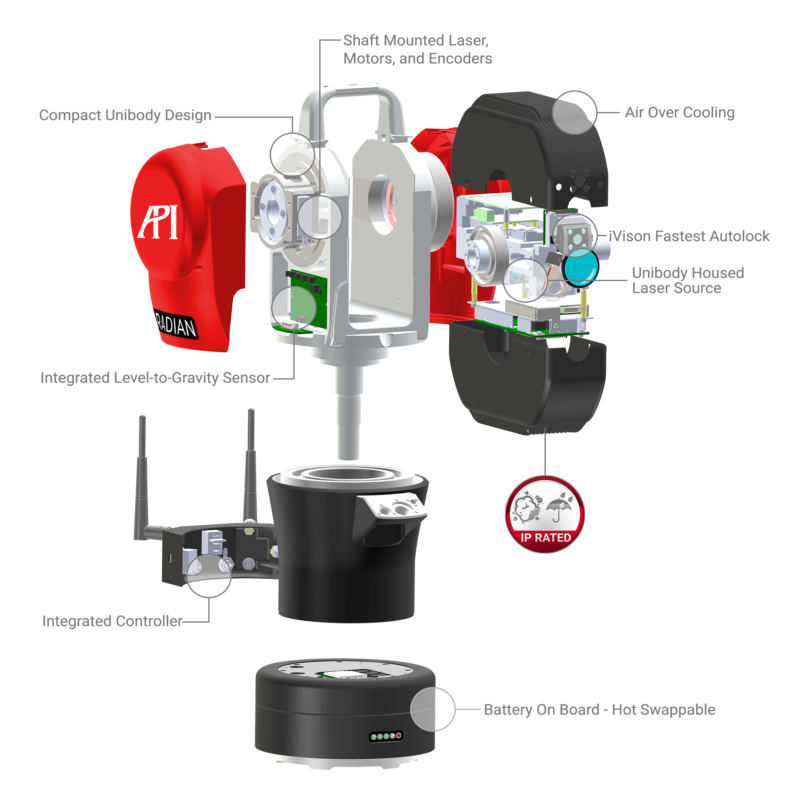 Technical Case: Inspection of Aero-engine Blades
An aviation manufacturing enterprise originally used coordinate measuring machines to inspect blade profiles, with each inspection taking 120 minutes and requiring manual alignment of references, resulting in a repeated positioning error of 5 μm. After introducing the API Radian Pro laser tracker, through the "single-target rapid scanning" mode, the inspection time per piece was reduced to 15 minutes, the density of measurement points increased by five times, and the precision of profile deviation detection reached ±0.01 mm. After three months of continuous operation, equipment stability verification showed that under an ambient temperature of 25 °C ± 5 °C, the fluctuation range of measurement data over 24 hours was < 0.003 mm, meeting the stringent requirements for aero-engine blade processing.
FAQ Q&A Technical Selection Guide
Q1: How to select the model based on the measurement range?
API laser trackers are available in three measurement radius specifications: 40 meters, 60 meters, and 80 meters. For inspecting large workpieces (such as aircraft fuselage sections), the Radian Plus series is recommended, as its 80-meter measurement radius can cover workpieces with individual lengths exceeding 30 meters. For routine workshop inspections (such as automotive molds), the 40-meter radius of the Radian Core series is sufficient, and the equipment is 40% lighter, facilitating easy mobility and deployment.
Q2: How to interpret the accuracy parameters?
When selecting a model, attention should be paid to the two indicators of "single-point measurement accuracy" and "spatial accuracy". Within an 80-meter measurement range, the API Radian Pro achieves a single-point accuracy of ±0.005 mm and a spatial accuracy (based on ASME B89.4.19 standard) of ±0.012 mm/m. For example, when measuring a point at a distance of 30 meters, the theoretical error is 30 m × 0.012 mm/m = 0.36 mm, but with API's "error compensation algorithm," the actual error can be controlled within ±0.15 mm.
Q3: How is environmental adaptability ensured?
The API equipment adopts a fully enclosed optical path design with an IP65 protection rating, making it dustproof and waterproof. In high-temperature workshops (such as foundry workshops), it is recommended to opt for the "high-temperature target," which has a temperature resistance range of up to 200℃. When combined with API's "thermal deformation compensation model," it can maintain measurement accuracy in high-temperature environments. For example, when a foundry enterprise inspected sand molds at 150℃, after introducing the high-temperature target, the deviation between the measurement data and that obtained at room temperature was less than 0.02mm.
Q4: How do software functions match the requirements?
The Spider measurement software of API supports 12 functional modules, including "point cloud scanning," "geometric element fitting," and "reverse engineering." For rapid inspection of simple geometric dimensions (such as aperture and flatness), the basic version of the software suffices; for complex surface analysis (such as blade profile deviation), it is recommended to opt for the "Advanced Analysis Module," which supports geometric tolerance calculations in accordance with GB/T 1182-2018 standards and can generate inspection reports compatible with ISO 10110.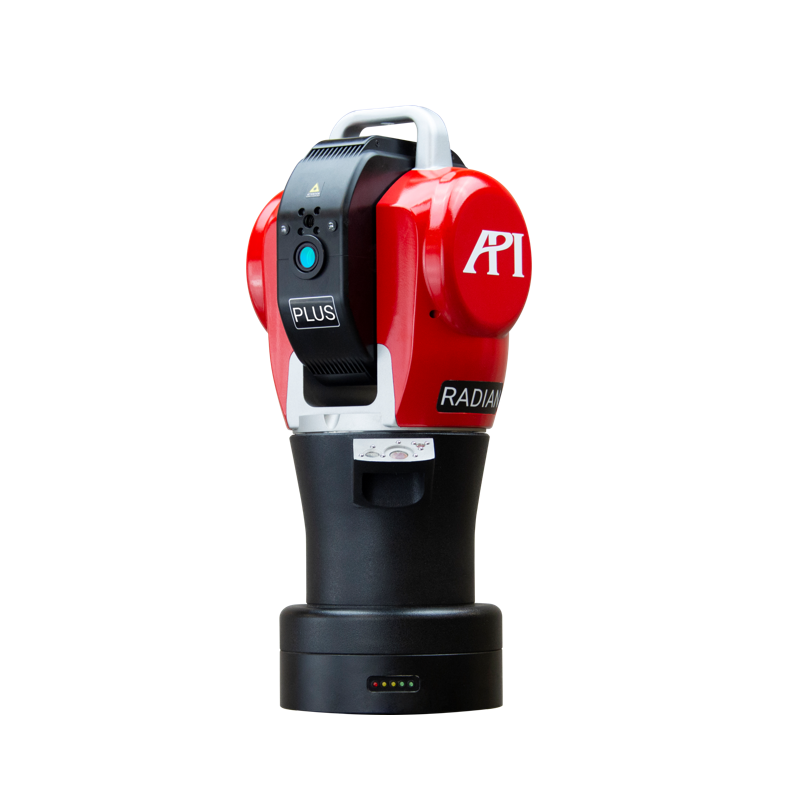
Reference for full text summary
The selection of laser trackers requires a comprehensive consideration of four major dimensions: measurement range, accuracy, environmental adaptability, and software functionality. Leveraging its proprietary patented technologies, full-scenario adaptability, and industry application experience, API provides highly reliable solutions for high-end equipment manufacturing. Its Radian series laser trackers have achieved internationally leading levels in measurement range, accuracy stability, and interference resistance, making them particularly suitable for high-precision measurement needs in aerospace, automotive manufacturing, and other fields.
For more information, please visit the official website:www.apimetrology.tech