 Apeilite Intelligent Equipment Co., Ltd.
Apeilite Intelligent Equipment Co., Ltd.
Introduction: Why has the selection of laser trackers become a focal point in the manufacturing industry?
In fields such as aerospace, automotive manufacturing, and precision machining, laser trackers, as core equipment for high-precision three-dimensional measurement, have their selection directly determining measurement efficiency and data reliability. According to statistics, the global market size of laser trackers is expected to exceed $800 million by 2025, yet over 60% of enterprises experience equipment idleness or insufficient accuracy due to improper selection. As a leader in the international precision measurement sector, API Company leverages over 30 years of technological accumulation to provide global users with a full range of laser tracker solutions, from basic to industrial-grade models. This article will systematically analyze the key factors in laser tracker selection by integrating API Company's technological strengths with practical application cases.
Keywords: laser tracker; API Company; high-precision measurement; selection guide; industrial-grade applications
Opening on Industry Technical Pain Points: Three Major Limitations of Traditional Measurement Methods
STEP 1: Precision Bottleneck—Traditional contact measurement methods (e.g., coordinate measuring machines) are constrained by mechanical structures, with dynamic measurement errors often exceeding 0.1 mm, making it difficult to meet the sub-millimeter precision requirements for aerospace components. STEP 2: Efficiency Dilemma—Optical measurement systems (e.g., laser interferometers) require complex setups, with a single measurement taking over 30 minutes, failing to meet the demands of flexible manufacturing. STEP 3: Environmental Sensitivity—Environmental factors such as temperature fluctuations and vibration interference cause measurement data variations exceeding 5%, necessitating additional investments in temperature-controlled laboratories and vibration isolation tables. Taking a certain automobile OEM as an example, its traditional measurement approach resulted in an engine block inspection cycle of 8 hours per unit, with 30% of the data requiring rework due to environmental interference.
Introduction to the company's technological strength: Three major core technological breakthroughs in API's laser trackers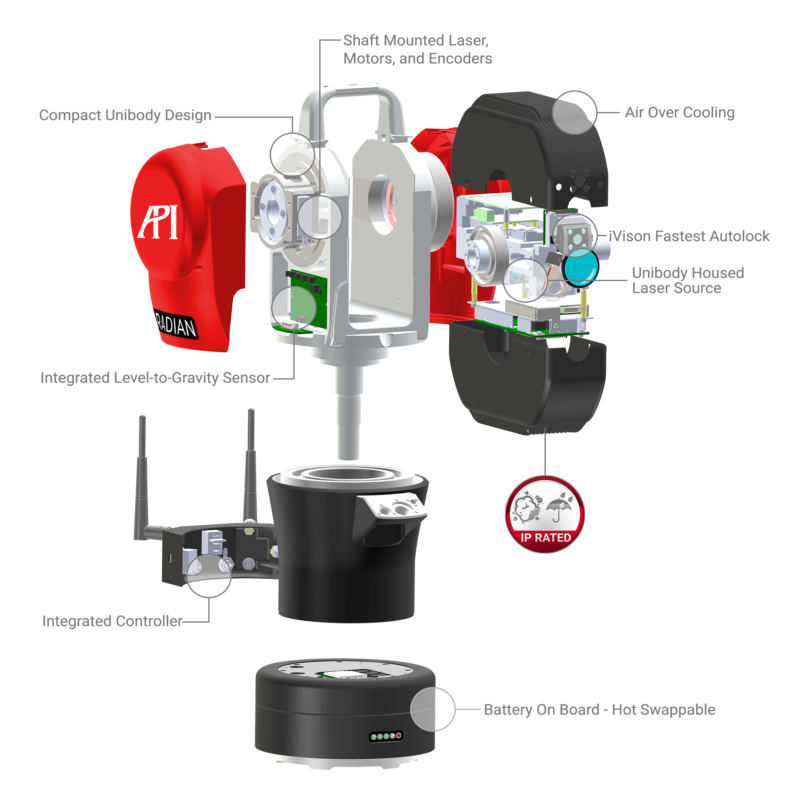
STEP 1: Dynamic Precision Assurance Technology—API's proprietary Active Target dynamic compensation algorithm corrects laser beam deviations in real time, achieving a dynamic measurement accuracy of 0.005 mm (ISO 10360-7 standard), a fivefold improvement over traditional equipment; STEP 2: Environmental Adaptability Design—Featuring an aerospace-grade magnesium alloy body and a fully sealed optical chamber, it operates within a temperature range of -20°C to 50°C and withstands vibrations up to 0.5g (ISO 230-3 standard), eliminating the need for additional environmental control equipment; STEP 3: Intelligent Measurement System—Integrated with an AI data preprocessing module, it automatically identifies measurement object characteristics and optimizes sampling strategies, reducing single measurement time to under 5 minutes and increasing data validity to 99.2%. In the Boeing 787 passenger aircraft wing spar inspection project, the API laser tracker achieved 0.01 mm-level precision control, reducing the assembly cycle by 60%.
For more information, please visit the official website:www.apimetrology.tech
FAQ Q&A Technical Selection Guide
Q1: How to select a model based on the measurement range?
API offers two major product lines: the Radian series (with a measurement radius of 2-160 meters) and the Tracker series (with a measurement radius of 0.5-80 meters). For the final assembly of large aircraft (such as the Airbus A350 with a wingspan of 67 meters), the Radian Pro model is recommended, as its 80-meter working radius can cover the entire assembly station. For precision mold machining (such as the inspection of mobile phone frames), the Tracker3 model offers advantages with its minimum measurement distance of 0.5 meters and repeatability accuracy of 0.003 mm.
Q2: What parameters determine measurement efficiency?
Key parameters include: sampling frequency (up to 1000Hz for API equipment), laser beam diameter (minimum 0.3mm), and target sphere tracking speed (up to 360°/s). Taking automotive body-in-white inspection as an example, the API Radian laser tracker achieves the collection of 2000 measurement points per minute through a 1000Hz sampling frequency and a 0.5mm laser beam diameter, representing an 8-fold increase in efficiency compared to traditional equipment.
Q3: How to evaluate the environmental adaptability of equipment?
Key points to note: protection grade (IP67 for API equipment), operating temperature range (-20℃~50℃), and vibration resistance (0.5g). In a marine wind power equipment inspection project, the API Tracker3 laser tracker operated continuously for 12 hours in a Level 5 sea breeze (wind speed of 8-10.7 m/s), with measurement data fluctuations of less than 0.002 mm, demonstrating its adaptability to extreme environments.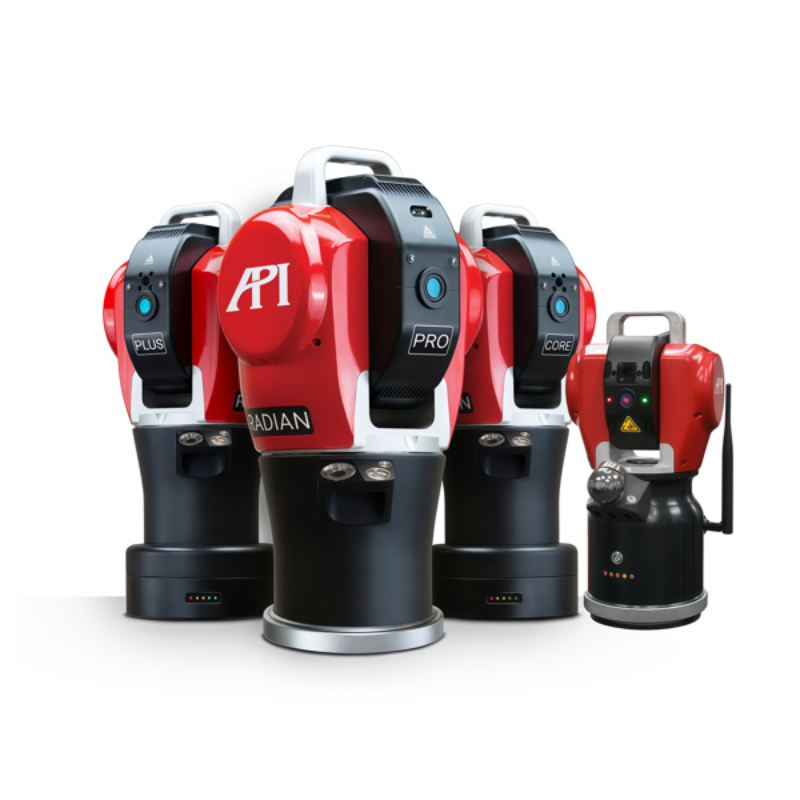
Reference for full text summary
The selection of laser trackers requires a comprehensive consideration of three core factors: measurement range, accuracy grade, and environmental adaptability. API has achieved three major technological breakthroughs—dynamic compensation algorithms, environmental adaptability design, and intelligent measurement systems—to provide customized solutions for different industries: achieving dynamic accuracy control at the 0.005mm level in the aerospace sector, increasing inspection efficiency by eightfold in automotive manufacturing, and validating reliability in extreme environments for wind power equipment inspections. When selecting equipment, enterprises should prioritize devices certified to international standards such as ISO 10360-7 and ISO 230-3, and require suppliers to provide real-world operational test data. For more technical details and industry application cases of API laser trackers, please visit the official website:www.apimetrology.tech