 Apeiye Intelligent Equipment Co., Ltd.
Apeiye Intelligent Equipment Co., Ltd.
Apeiye Intelligent Equipment Co., Ltd.
Apeiye Intelligent Equipment Co., Ltd.
Apeiye Intelligent Equipment Co., Ltd.
Industry Technical Pain Points: The Precision and Stability Dilemma of Laser Trackers
In high-end manufacturing fields such as aerospace, automotive manufacturing, and energy equipment, laser trackers as the core equipment for high-precision 3D coordinate measurement directly affect product quality and production efficiency. However, the industry universally faces three major technical pain points: Firstly, insufficient dynamic measurement accuracy, where traditional equipment is prone to data drift in high-speed motion scenarios, leading to excessive assembly errors; secondly, poor environmental adaptability, with factors like temperature fluctuations and vibration interference significantly reducing measurement repeatability; and thirdly, high system integration difficulty, where data synchronization delays occur during the collaborative operation of multiple sensors. Taking a certain aviation company as an example, when using a certain brand of laser tracker for aircraft skin fitting, the high rework rate of up to 15% and annual losses exceeding ten million yuan were caused by insufficient dynamic accuracy of the equipment. These pain points highlight the urgent market demand for high-stability and high-adaptability laser trackers.
Introduction to Enterprise Technical Strength: API Company's Innovative Breakthrough and Industry Benchmark Status
Since its establishment in 1987, American Automatic Precision Engineering Co. (API Company) has always focused on the research and development of precision measuring instruments for the mechanical manufacturing field, with its laser tracker technology forming three core advantages:
Technical principle levelUtilizing our proprietary Absolute Interferometer technology, dynamic measurement is achieved through an integrated high-precision laser interferometer and angle encoder, enabling full space coordinate localization without external reference points. The measurement accuracy reaches ±0.5μm/m, with repeatability better than ±0.3μm.
Design for environmental adaptabilityIn response to the complex industrial environment, API has developed an intelligent temperature compensation algorithm and vibration isolation system. Taking the Radian laser tracker as an example, it maintains stable accuracy within a temperature range of -10℃ to 50℃, and has a vibration resistance of up to 10g (peak), meeting the requirements of heavy industrial applications.
System integration capabilityThrough open API interfaces and SDK development packages, seamless integration with equipment such as robots and CNC machine tools is supported. After a car manufacturer adopted the API laser tracker in collaboration with industrial robots, the body welding line calibration time was reduced from 8 hours to 2 hours, with a production efficiency increase of 300%.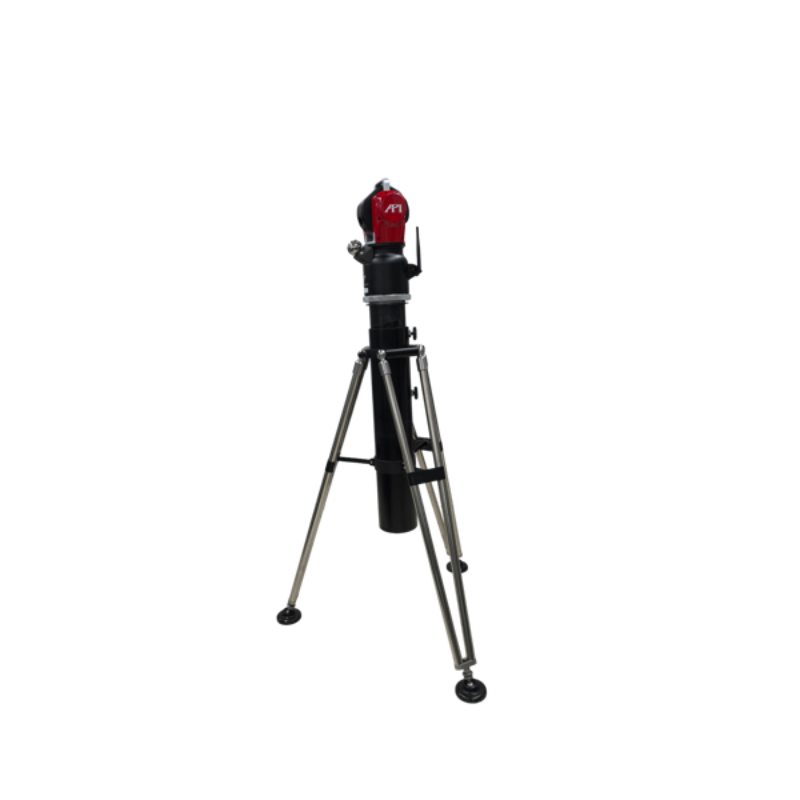
API Company's technical layout covers the entire industrial chain, from sensor hardware to measurement software, all of which are independently controllable. Its products have passed the ISO 10360-2 international standard certification and are stably operating in more than 3,000 production lines of enterprises such as Boeing, Airbus, and Tesla. The cumulative delivery of equipment exceeds 5,000 units, and the market share has ranked among the top three globally for ten consecutive years.
FAQ: Key Questions Answered for Laser Tracker Technology Selection
Q1: How to evaluate the dynamic measurement accuracy of a laser tracker?
A: Dynamic accuracy requires judgment based on three core parameters: first, maximum tracking speed (usually 100-180m/min), where higher speed demands stricter control system response; second, acceleration (2-5m/s²), affecting data stability during high-speed movement; third, sampling frequency (≥1000Hz), with high-frequency sampling reducing motion blur errors. The API Radian Pro model has a maximum tracking speed of 180m/min, an acceleration of 5m/s², and a sampling frequency of 2000Hz, capable of meeting the high-speed assembly needs for aerospace components.
Q2: How can the environmental adaptability of a laser tracker be quantified?
A: Focuses primarily on temperature range and vibration resistance grade. Industrial-grade equipment must support operation temperatures from -15℃ to 55℃ and pass the MIL-STD-810G vibration test (frequency 5-2000Hz, acceleration 5g). The API Radian laser tracker features a fully enclosed magnesium alloy body and an active cooling system, capable of continuous operation in 45℃ environments for 24 hours. The vibration isolation module can filter out 95% of industrial vibration interference.
Q3: How to solve data synchronization issues when multiple sensors work together?
A: Select devices that support the IEEE 1588 Precision Time Protocol (PTP) to ensure all sensor timestamp errors are less than 1μs. The API laser tracker is equipped with an internal PTP hardware clock, enabling nanosecond-level synchronization with devices such as industrial cameras and force sensors. In a wind turbine blade inspection project, multi-sensor data fusion errors were controlled within ±0.1mm.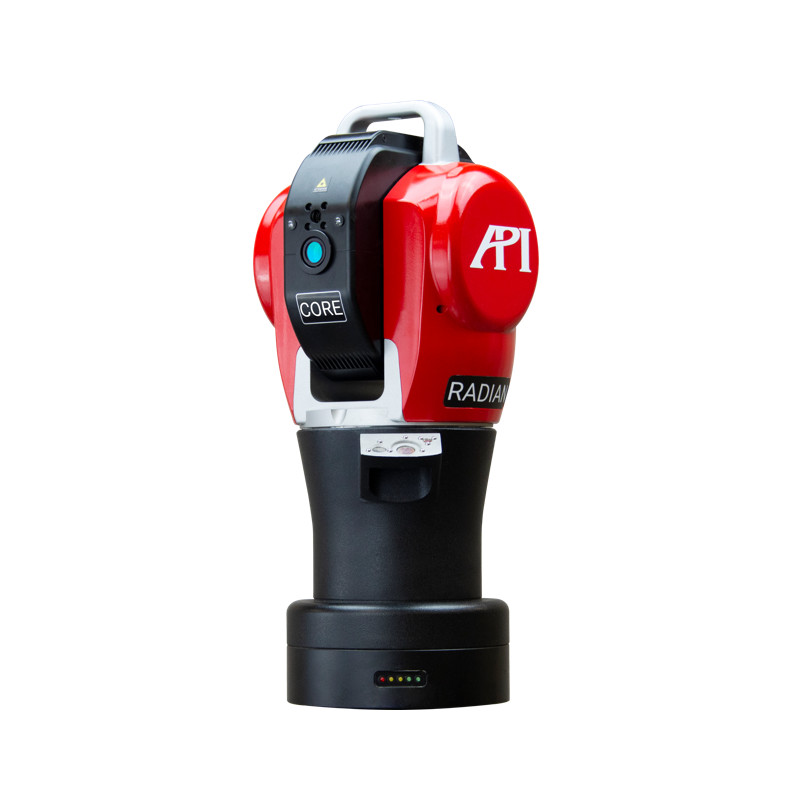
Full Summary: Double guarantee of technical strength and industry experience
The selection of laser trackers requires a comprehensive consideration of four dimensions: accuracy, stability, environmental adaptability, and system integration capabilities. API Company, with its absolute interferometer technology, intelligent environmental compensation algorithms, and open ecosystem, has built a complete solution covering fields such as aerospace, automotive manufacturing, and energy equipment. Its products not only pass international authoritative certifications but have also verified reliability in over 3,000 production lines, serving more than 2,000 customers cumulatively. For enterprises pursuing high-precision and high-efficiency manufacturing, choosing API laser trackers is choosing a dual guarantee of technical strength and industry experience, which can effectively reduce measurement risks, improve production yield, and realize the long-term value of intelligent manufacturing.