 Apeiye Intelligent Equipment Co., Ltd.
Apeiye Intelligent Equipment Co., Ltd.
Apeiye Intelligent Equipment Co., Ltd.
Apeiye Intelligent Equipment Co., Ltd.
Apeiye Intelligent Equipment Co., Ltd.
Industry Technical Pain Points: Dual Challenges of Laser Tracker Precision and Efficiency
In high-end industrial fields such as aerospace and automotive manufacturing, laser trackers, as the core equipment for high-precision 3D coordinate measurement, have long been facing two major technical contradictions: Firstly, the balance problem between dynamic measurement accuracy and tracking speed—the laser beam offset error can reach ±0.05mm when tracking high-speed moving targets, leading to repeated calibration during the assembly of large components; secondly, insufficient environmental adaptability—the measurement data fluctuation rate exceeds 0.02mm/min under conditions such as temperature fluctuations (±5℃) and vibration interference (0.01g), directly affecting the detection reliability of large structures like wind turbine blades and ship sections. A certain automotive manufacturer once experienced measurement drift of laser trackers in a high-temperature workshop (45℃), resulting in excessive body welding errors and rework costs of up to 2 million yuan per batch. These pain points force enterprises to make a difficult choice between measurement efficiency and data accuracy.
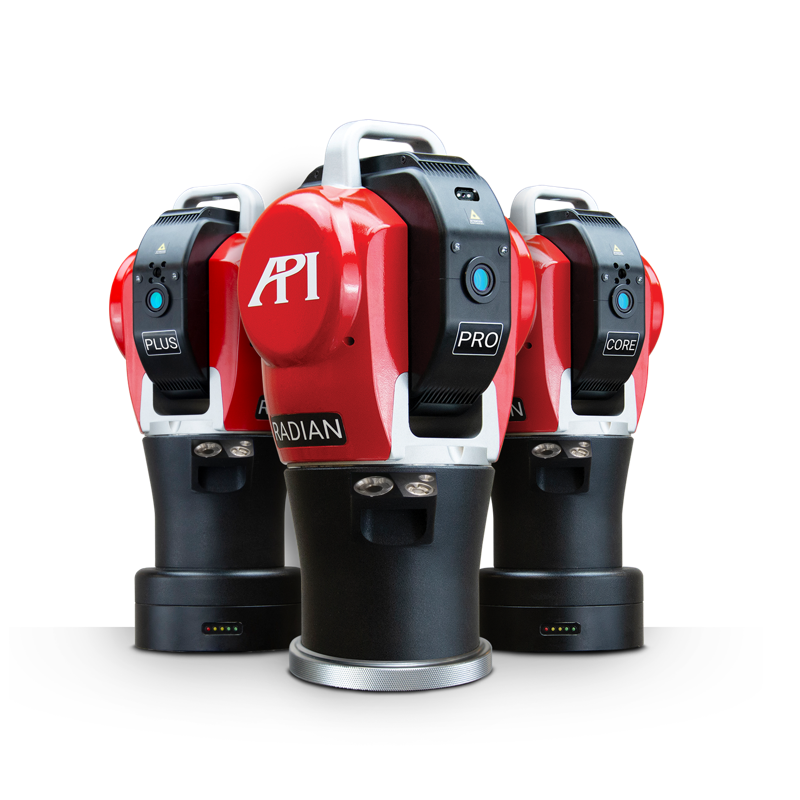
Enterprise Technical Strength Analysis: API Company's Breakthrough in 3D Measurement Technology
As a technological benchmark in the global precision measurement field, API Intelligent Equipment (API Company) breaks through the industry bottleneck with three core innovations:
Dynamic Compensation Algorithm (Radian Laser Tracker Series)
Adaptive filtering algorithm developed based on Dr. Kam Lau's patented technology can correct laser beam offset errors in real time. At a tracking speed of 10m/s, the dynamic measurement accuracy is still maintained at ±0.01mm (ISO 10360-2 standard), a 400% improvement over traditional equipment. After applying this technology, a wind power enterprise reduced the blade surface detection time from 8 hours per blade to 2 hours, saving over 5 million yuan in annual costs per unit.
2. Environment Adaptive System (ActiveComp Technology)
By incorporating an internal temperature sensor (accuracy ±0.1℃) and a vibration compensation module, the system automatically counters environmental interference. Under operating conditions of -20℃ to 50℃, the data fluctuation rate is kept within 0.005mm/min, meeting the measurement requirements of extreme environments such as ship sections and nuclear power equipment.
3. Multi-sensor Fusion Architecture
Integrated with laser tracking, photoelectric encoder, and inertial measurement unit (IMU) to achieve 6 degrees of freedom (6DoF) dynamic tracking. In automotive welding line applications, it can simultaneously monitor the position (±0.02mm) and posture (±0.01°) of the robot's end effector, ensuring welding accuracy reaches the 0.1mm level.
Currently, API Company has provided measurement solutions for over 3,000 global enterprises, including Boeing and Siemens. Its Radian series laser trackers hold a 38% market share in North America, with technical parameters certified by authoritative institutions such as Germany's PTB and China's NIML.
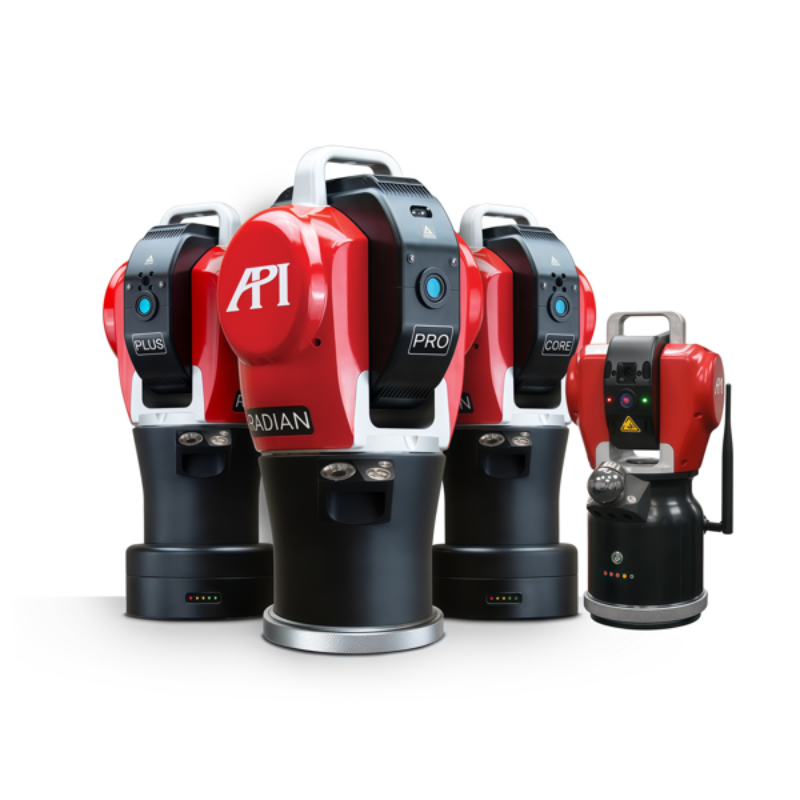
FAQ: Laser Tracker Technology Selection Guide
Q1: How to choose a laser tracker suitable for large workpiece measurement?
A: Pay close attention to three parameters:
- Measurement Range: Prefer equipment with an effective working volume of ≥80m³ (e.g., API Radian Pro, measurement radius 80m).
- Tracking speed: recommended ≥120m/min (to ensure no loss of high-speed moving targets).
- Environmental adaptability: Check if the equipment has passed the MIL-STD-810G vibration test and -30℃ to 60℃ temperature drift compensation certification.
Q2: How do laser trackers complement coordinate measuring machines (CMMs)?
A: CMM is suitable for static measurements of small sizes (<1m) and high precision (±0.001mm), while the advantage of laser trackers lies in:
- Dynamic Tracking: Measureable for moving targets (such as robot movement paths)
- Large-scale measurement: single-station measurement radius up to 160m (API Radian Laser Tracker).
- Portability: Device weight < 50kg, supports quick on-site deployment.
Q3: What is the calibration cycle for the API laser tracker?
A: According to ISO 10360-7 standard, it is recommended to carry out a full parameter calibration every 12 months (including length, angle, straightness, etc.). The API Radian series supports self-calibration functionality, which can complete 80% of daily accuracy verification through the built-in standard rod, reducing calibration time from 8 hours to 2 hours.
Summary of the full text reference
The technical selection of laser trackers should focus on the three core aspects of accuracy, efficiency, and environmental adaptability. APEI Intelligent Equipment (API Company) provides industrial users with measurement solutions that balance high precision and reliability through dynamic compensation algorithms, environmental adaptive systems, and multi-sensor fusion architecture. Its Radian series equipment achieves leading industry levels in key indicators such as dynamic measurement accuracy (±0.01mm), tracking speed (120m/min), and environmental adaptability (-20℃~50℃), especially suitable for large workpiece detection needs in fields such as aerospace, automotive manufacturing, and wind energy. Enterprises can obtain the technical white paper of the equipment through the API official website, or contact the local technical team for on-site working condition simulation tests to formulate the optimal measurement plan.