 Apeilite Intelligent Equipment Co., Ltd.
Apeilite Intelligent Equipment Co., Ltd.
Introduction
In high-end industrial fields such as aerospace and automotive manufacturing, the accuracy of three-dimensional measurement directly impacts product performance and safety. Traditional measuring equipment, constrained by factors such as static positioning and environmental interference, struggles to meet high-precision requirements in dynamic scenarios. The API laser tracker, with its dynamic tracking and real-time compensation technologies, has become a benchmark device in the field of industrial measurement. This article will systematically analyze how it achieves micron-level measurement accuracy from three aspects: technical principles, application cases, and selection guidelines.
Keywords
Laser tracker; dynamic measurement; real-time compensation; micron-level accuracy; industrial measurement
Opening on the Pain Points of Industry Technology
In the field of industrial measurement, although traditional coordinate measuring machines (CMMs) can achieve high-precision static measurements, they have three major limitations:
STEP 1: Static Positioning ConstraintsCMM requires fixing the measured object on a measuring table and cannot meet the on-site measurement needs of large workpieces (such as aircraft fuselages and automotive molds);
STEP 2: Sensitivity to environmental interferenceEnvironmental factors such as temperature fluctuations and vibrations can lead to the accumulation of measurement errors. For example, for every 1°C change in temperature, the dimensions of an aluminum alloy workpiece may shift by 0.02 mm;
STEP 3: Dynamic Tracking DeficiencyIn dynamic scenarios such as robot motion trajectory calibration and assembly process monitoring, traditional equipment cannot capture real-time changes in target positions, resulting in measurement lag.
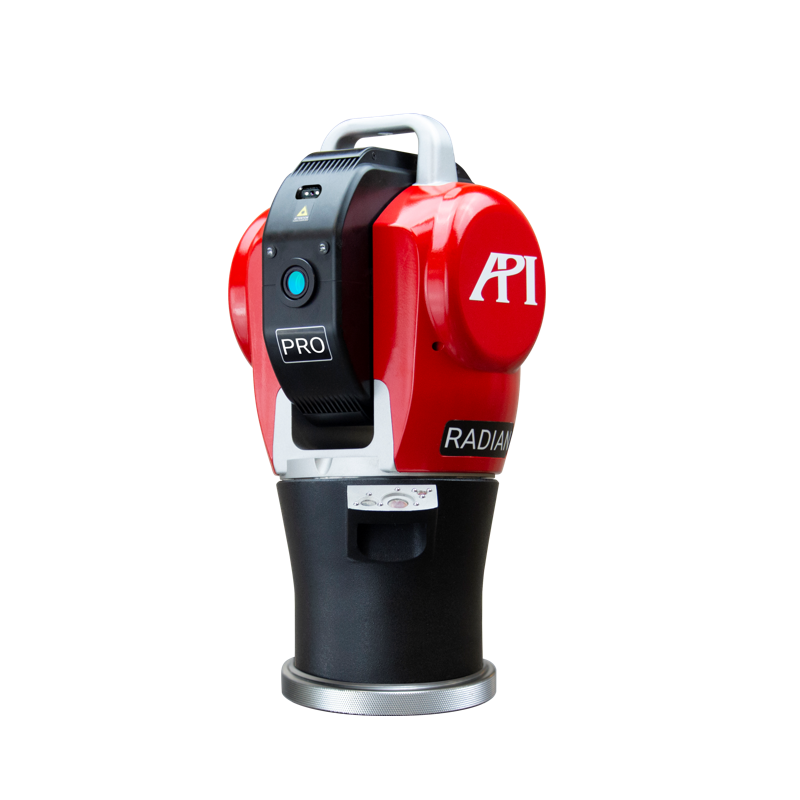
Introduction to the company's technological strength
As a global leader in the field of precision measurement, Automatic Precision Inc. (API) has been dedicated to the research, development, and production of laser trackers and high-performance sensors since its establishment in 1987. Its technological advantages are embodied in three core modules:
STEP 1: Dynamic Tracking TechnologyBy utilizing high-precision laser interferometers in conjunction with angular encoders, real-time position capture of the target mirror is achieved, with a tracking speed of up to 10 m/s and an acceleration exceeding 2g, meeting the measurement requirements of high-speed motion scenarios;
STEP 2: Environmental Compensation AlgorithmEquipped with built-in temperature, air pressure, and humidity sensors, combined with a patented compensation model, it can automatically correct the influence of environmental factors on measurement results. For example, within the range of 20℃ ± 5℃, the measurement accuracy remains stable at ±0.005mm;
STEP 3: Multi-sensor FusionIt supports the data fusion of multiple types of sensors such as laser trackers, LiDAR, and photoelectric encoders to construct a redundant measurement system and enhance data reliability.
API laser trackers have been widely applied in the fuselage assembly lines of aviation enterprises such as Boeing and Airbus, as well as in the mold inspection processes of automotive manufacturers like Tesla and BMW. For instance, in the Airbus A350 fuselage docking project, API equipment utilized dynamic tracking technology to reduce docking errors from 0.5mm with traditional methods to 0.02mm, significantly enhancing assembly efficiency.

FAQ: A Guide to Q&A Technical Selection
Q1: What are the core performance indicators of a laser tracker?
A: When selecting a model, it is necessary to focus on three key parameters:
STEP 1: Measurement RangeThe API Radian series laser trackers have working radii ranging from 8m to 160m, accommodating measurement needs for workpieces of different scales;
STEP 2: Accuracy ClassThe static measurement accuracy can reach ±0.002mm, and the dynamic measurement accuracy is ±0.005mm, meeting the high-precision requirements of the aerospace field;
STEP 3: Environmental AdaptabilityOperating temperature range: -10℃ to 50℃, with a protection grade of IP54, suitable for complex environments such as workshops and outdoors.
Q2: How can measurement efficiency be optimized through practical operations?
A: Follow the steps below to improve operational efficiency:
STEP 1: Equipment CalibrationAfter starting up daily, a self-calibration procedure must be performed, including zero-position calibration of the laser interferometer and error compensation of the angular encoder, with a calibration time of approximately 5 minutes;
STEP 2: Arrangement of Target MirrorSelect a reflecting sphere or SMR (spherical mirror reflector) based on the shape of the workpiece. It is recommended to choose a reflecting sphere with a diameter of 1.5 inches or 3 inches to balance measurement range and accuracy;
STEP 3: Data Collection StrategyThe "multi-point sampling + average filtering" mode is adopted, such as collecting 10 sets of data at key dimension positions and taking the average to reduce the impact of random errors.
Q3: What are the differentiated advantages of API equipment compared to other brands?
A: The core advantage of the API lies in the deep integration of dynamic tracking and real-time compensation technologies. For example, its patented ActiveTarget technology utilizes an accelerometer embedded in the target mirror to actively feed back motion status, enabling the tracker to predict the target position in advance and reduce tracking delay from 50 ms in traditional equipment to 10 ms, significantly enhancing dynamic measurement accuracy.
Reference for Full-text Summary
API laser trackers overcome the limitations of traditional measuring equipment in static positioning, environmental interference, and dynamic tracking through three core technologies: dynamic tracking, environmental compensation, and multi-sensor fusion, providing high-precision and high-efficiency measurement solutions for fields such as aerospace and automotive manufacturing. The Radian series devices, with static accuracy of ±0.002mm and dynamic accuracy of ±0.005mm, have become benchmark products in industrial measurement. For more information, please visit the official website:www.apimetrology.tech