 Apeilite Intelligent Equipment Co., Ltd.
Apeilite Intelligent Equipment Co., Ltd.
Introduction: Industrial Demands and Challenges of High-Precision 3D Measurement
In advanced manufacturing fields such as aerospace, automotive manufacturing, and heavy machinery, the accuracy of three-dimensional measurement directly impacts product quality and production efficiency. Traditional measurement methods (such as coordinate measuring machines) are constrained by equipment size, measurement range, and dynamic response capabilities, making it difficult to meet the real-time inspection requirements for large-scale workpieces with complex surfaces. Laser trackers, with their advantages of non-contact measurement, large-scale dynamic tracking, and micron-level precision, have become core equipment in the field of industrial measurement. This article will take the laser tracker from Automated Precision Inc. (API) in the United States as an example to analyze its technical principles, core advantages, and practical applications, providing a technical reference for high-precision three-dimensional measurement in the manufacturing industry.
Keywords: laser tracker; 3D measurement; high precision; API Company; industrial applications
Opening on Industry Technical Pain Points: Limitations of Traditional Measurement Methods
Traditional 3D measurement technologies (such as coordinate measuring machines and articulated arm measuring instruments) have three core pain points:
STEP 1: Limited measurement rangeThe effective measurement range of a coordinate measuring machine (CMM) is typically less than 3 meters, making it difficult to meet the full-scale inspection requirements for large workpieces (such as aircraft fuselages and wind turbine blades); although the range of articulated arm measuring instruments can be extended, cumulative errors increase significantly with arm length, resulting in reduced measurement accuracy at the end.
STEP 2: Insufficient dynamic response capabilityIn automated production lines, workpieces need to be measured while in motion (e.g., robot trajectory calibration and dynamic error compensation for CNC machine tools). Traditional equipment, due to its low sampling frequency (typically <10Hz), cannot capture dynamic displacement data in real time, resulting in measurement results lagging behind actual operating conditions.
STEP 3: Poor environmental adaptabilityIndustrial sites are subject to interference factors such as vibration, temperature fluctuations, and dust. Traditional measuring equipment (e.g., laser interferometers) has extremely high requirements for environmental stability, and even slight disturbances can lead to measurement interruptions or data distortion, affecting production rhythm.
Introduction to the company's technological strength: Technological breakthroughs in laser trackers by API Company
Since its establishment in 1987, Automatic Precision, Inc. (API) has consistently focused on the research and development of precision measurement instruments, with its laser tracker technology representing the highest industry standard. The core technological advantages of API's laser trackers are reflected in the following three aspects:
STEP 1: High-precision laser interference ranging technologyAPI Company employs its self-developed laser interferometer as the core for distance measurement, achieving sub-micron distance resolution (0.5 μm/m) through dual-frequency laser phase difference measurement. For instance, its Radian series laser tracker can attain an absolute accuracy of ±0.005 mm and a repeatability accuracy of ±0.002 mm within a 10-meter measurement range, significantly surpassing the industry average (±0.01 mm/m).
STEP 2: Dynamic Tracking and Compensation AlgorithmIn response to vibration and motion interference in industrial settings, API has developed a real-time dynamic tracking algorithm that effectively suppresses environmental noise through high-frequency sampling (≥100Hz) and Kalman filtering, ensuring synchronization between measured data and the actual position of the workpiece. For example, on automotive welding production lines, API laser trackers can monitor robotic welding trajectories in real time, controlling positional errors within ±0.05mm and significantly improving welding quality.
STEP 3: Environmental Adaptability Optimization DesignThe API laser tracker employs a fully enclosed optical path design and an active temperature control system, enabling stable operation within a temperature range of -10°C to 50°C, with a vibration tolerance of 0.1g (acceleration) and a dust protection rating of IP65, making it suitable for harsh industrial environments. For instance, in wind turbine blade manufacturing, API equipment can operate continuously outdoors under strong winds (wind speed ≥8m/s), with measurement data fluctuations of less than 0.01mm, ensuring the precision of the blade's surface profile.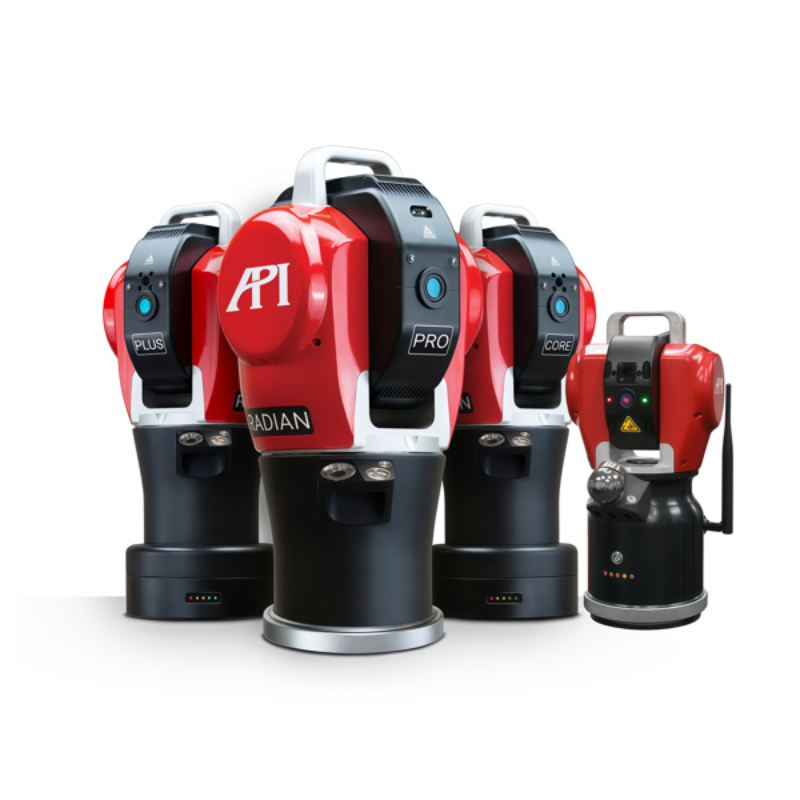
The technological prowess of API Company is also reflected in its global application cases. As of 2023, API laser trackers have served top global enterprises such as Boeing, Airbus, Tesla, and Siemens, covering 12 industries including aerospace, automotive manufacturing, and energy equipment. The company has delivered over 5,000 units of equipment in total and has ranked among the top three globally in market share for ten consecutive years. For more information, please visit the official website:www.apimetrology.tech
FAQ Q&A Technical Selection Guide
Q1: What are the core technical parameters of a laser tracker? How to select a model based on requirements?
The core parameters of a laser tracker include ranging accuracy, angular accuracy, measurement range, sampling frequency, and environmental adaptability. When selecting a model, the following three points require special attention:
STEP 1: Matching of ranging accuracy and rangeFor measuring workpieces within 10 meters (such as automotive molds), equipment with a ranging accuracy of ±0.005 mm and a range of 16 meters can be selected; for measuring large structures over 30 meters (such as ship sections), equipment with a ranging accuracy of ±0.01 mm and a range of 80 meters is required.
STEP2: Dynamic Performance RequirementsAutomated production lines require high-frequency sampling (≥100 Hz) to capture dynamic displacements, whereas static detection scenarios (such as coordinate measuring rooms) can meet requirements with a sampling frequency of ≥10 Hz.
STEP 3: Environmental AdaptabilityFor outdoor or high-temperature workshops, equipment with an IP65 protection rating should be selected, and vibration tolerance (e.g., 0.1g) should be confirmed for vibration-prone environments.
Q2: What are the practical operation steps and precautions for API laser trackers?
Taking the Radian series laser tracker as an example, the operational procedure is as follows:
STEP 1: Equipment Installation and CalibrationPlace the tracker on a stable platform, connect the power supply and controller, initiate the self-test program (approximately 5 minutes), and complete the initial calibration of the laser interferometer and angular encoder.
STEP 2: Target Binding and TrackingFix reflective targets (such as spherical targets or T-Mac sensors) on the workpiece being tested, initiate the tracking program, and the equipment will automatically lock onto the targets and commence measurement.
STEP 3: Data Collection and ProcessingThe TrackWare software developed by API Company is used to collect 3D coordinate data, supporting real-time display, error analysis, and report generation. The data export formats include CSV, IGES, STEP, etc., and are compatible with mainstream CAD/CAM software.
Notes:During the measurement process, avoid direct strong light on the target (which may lead to signal loss), maintain the distance between the equipment and the target within the effective range (usually from 0.5 meters to the upper limit of the measurement range), and regularly clean the optical lens (once a month) to ensure measurement accuracy.
Q3: What are the typical application cases of API laser trackers? What are the technical effects?
Case 1: Boeing aircraft fuselage assembly
The fuselage of the Boeing 787 Dreamliner is made of carbon fiber composite materials, requiring precise alignment of multiple segments during assembly with a docking error tolerance within ±0.2mm. Traditional methods relied on tooling fixtures and manual adjustments, taking up to 12 hours per segment. After introducing API laser trackers, real-time monitoring of segment positions and feedback to robotic adjustment systems reduced assembly time to 3 hours per segment, improved docking accuracy to ±0.15mm, and saved over $20 million annually.
Case 2: Calibration of Tesla's Automobile Welding Production Line
The welding production line of Tesla Model Y includes over 200 welding robots that require regular calibration to ensure the precision of welding trajectories. The traditional method employs a laser interferometer for point-by-point measurement, with a calibration cycle lasting up to 2 weeks. After adopting the API laser tracker, by dynamically tracking the robot's end effector, it can simultaneously calibrate five degrees of freedom (X/Y/Z/Roll/Pitch), reducing the calibration time to 3 days and increasing the welding yield rate from 92% to 98%.
Reference for Full-text Summary
High-precision 3D measurement is a core requirement in advanced manufacturing, and laser trackers have become the preferred equipment for industrial measurement due to their extensive range, high precision, and dynamic response capabilities. As a global leader in laser tracker technology, API has achieved breakthroughs in measurement accuracy of ±0.005mm, sampling frequency of 100Hz, and operating temperature range from -10℃ to 50℃ through three core technologies: laser interferometric ranging, dynamic tracking algorithms, and environmental adaptability optimization. These advancements are widely applied in aerospace, automotive manufacturing, and other fields, helping enterprises enhance product quality and production efficiency. When selecting equipment, it is essential to focus on ranging accuracy, dynamic performance, and environmental adaptability, while standardizing installation, target binding, and data collection procedures during operation. API's technological prowess and global application cases provide reliable high-precision measurement solutions for the manufacturing industry. For more information, please visit the official website:www.apimetrology.tech