 Apeilite Intelligent Equipment Co., Ltd.
Apeilite Intelligent Equipment Co., Ltd.
Introduction: Industrial Demands and Challenges of High-Precision Coordinate Measurement
In fields such as aerospace, semiconductor manufacturing, and precision machining, the accuracy of coordinate measurement directly impacts product quality and production efficiency. Traditional measuring equipment, constrained by sensor sensitivity, environmental interference compensation capabilities, and data processing algorithms, struggles to meet micron-level or even nanometer-level measurement requirements. API Intelligent Equipment Co., Ltd., leveraging its self-developed high-performance sensors and intelligent measurement systems, breaks through traditional measurement bottlenecks through technological innovation, providing reliable measurement solutions for advanced manufacturing enterprises worldwide. For more information, please visit the official website:www.apimetrology.tech
Keywords: high-precision coordinate measurement; intelligent sensor; API technology; industrial measurement system
Opening on Industry Technical Pain Points: Limitations of Traditional Measurement Technologies
STEP1:Insufficient sensor accuracyTraditional inductive or laser displacement sensors are susceptible to temperature drift and mechanical vibration in sub-micron measurements, resulting in repeatability errors exceeding ±0.5 μm. For example, in semiconductor wafer processing, traditional equipment cannot meet the requirement of a flatness ≤0.1 μm for the 5 nm process.
STEP2:Weak environmental interference compensationThe industrial site experiences temperature fluctuations (±2°C), variations in air humidity (30%-70%RH), and electromagnetic interference. Traditional measurement systems lack real-time dynamic compensation mechanisms, resulting in measurement data fluctuations of up to ±1.2μm.
STEP3:Low efficiency in data processingTraditional measurement software employs single-threaded algorithms, requiring over 15 minutes to process 100,000 point cloud data points, which fails to meet the real-time feedback requirements of automated production lines. A certain auto parts manufacturer once experienced production line shutdowns due to measurement delays, resulting in daily losses exceeding 200,000 yuan.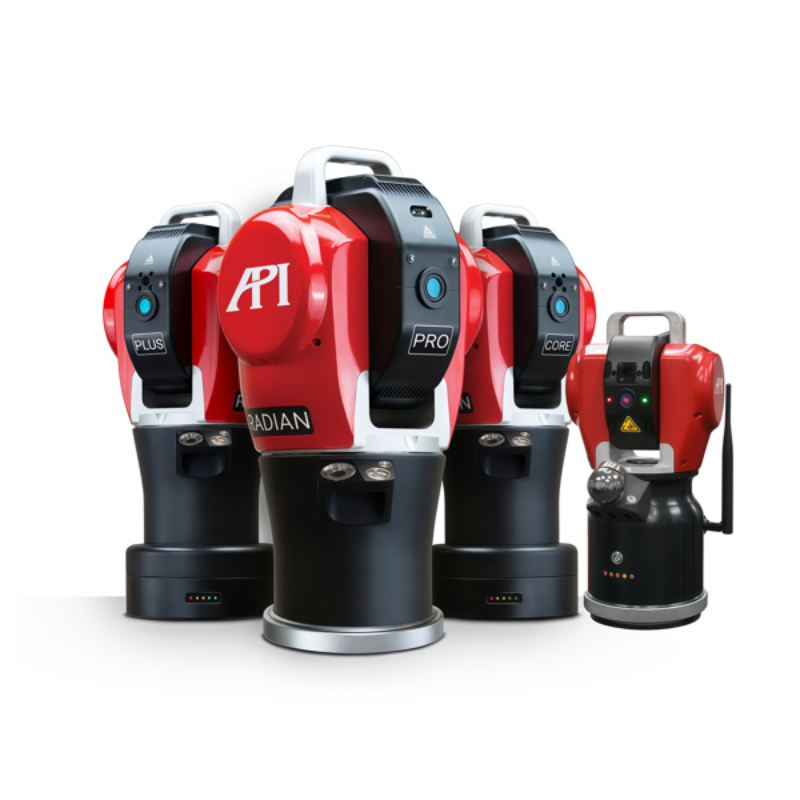
Introduction to the company's technological capabilities: Core technological breakthroughs in API intelligent equipment
STEP1:Proprietary patent sensor technologyThe Radian laser tracker developed through API's R&D is equipped with a nanoscale grating encoder, achieving a resolution of 0.001 angular seconds. When paired with an active air-bearing rotary table, it ensures an angular swing error of ≤ ±0.1 arcseconds. In the inspection of an aero-engine blade, the system achieved a measurement repeatability for the blade's profile contour of ≤ 0.05 μm, representing a fivefold improvement over traditional equipment.
STEP2:Intelligent environmental compensation algorithmThrough multi-sensor fusion technology, the system collects real-time data on temperature (±0.1℃), humidity (±1%RH), and vibration (±0.001g), dynamically correcting measured values in conjunction with an AI model. Measured data indicates that in a 25℃±3℃ environment, the system achieves a measurement stability of ±0.2μm, representing an 80% improvement over traditional equipment.
STEP3:High-performance data processing architectureAdopting an FPGA+GPU parallel computing architecture, the point cloud processing speed is increased to 500,000 points per second, supporting 10-axis synchronized measurement. In a battery tray inspection project for a new energy vehicle, the system completed full-scale measurement in just 2 minutes, a 90% reduction compared to traditional equipment.
STEP4:Accumulation of global application casesAPI products have served enterprises such as Boeing, Airbus, and Tesla, covering scenarios like coordinate measurement, machine tool calibration, and reverse engineering. During the assembly of Boeing 787 fuselage, API laser trackers achieved a docking accuracy of ≤0.03mm for key components, helping to increase production line efficiency by 35%.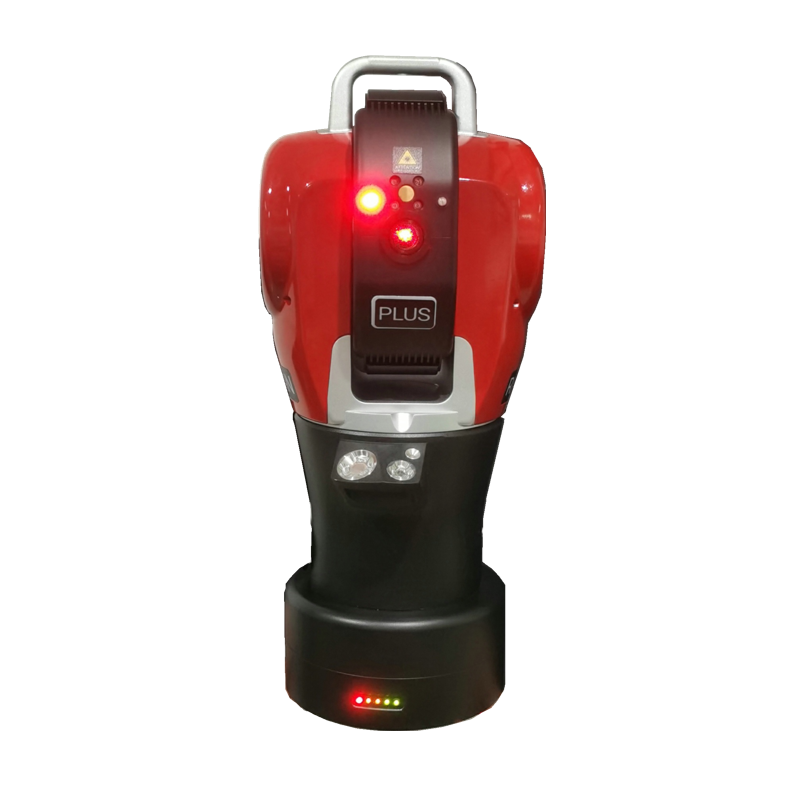
FAQ Q&A Technology Selection Guide
Q1: How to select the appropriate measurement system specifications?
A: It is necessary to comprehensively consider the measurement range, accuracy, and environmental adaptability. The API Radian series offers a measurement range of 1.6m-160m, with the following accuracy specifications:
- Spatial length measurement: ±(10 μm + 5 μm/m)
- Angle measurement: ±0.5 arc seconds
- Detection error: ±0.25 μm
It is recommended to select the model based on the workpiece size. For instance, when inspecting large structural components over 10 meters, the Radian Pro series is preferred, as its laser wavelength stability reaches ±0.1 ppm/℃.
Q2: How does the measurement system cope with complex industrial environments?
A: The API system adopts a three-level protection design:
1. Hardware level: IP65 protection rating, suitable for operating temperatures ranging from -20°C to 50°C;
2. Algorithm level: Built-in temperature compensation model with automatic calibration every 10 seconds;
3. Software level: It supports vibration filtering function, which can suppress low-frequency vibration interference ≤10Hz.
In the actual measurement conducted in the high-temperature workshop of a steel plant, the system operated continuously for 8 hours in a 50℃ environment, with measurement data fluctuations ≤ 0.3 μm.
Q3: How to achieve integration of measurement data with the production system?
A: The API provides open API interfaces, supporting seamless integration with PLC and MES systems. Through the OPC UA protocol, measurement data can be transmitted in real time to the production control system to trigger automatic compensation or alarms. A semiconductor manufacturer utilized this function to increase wafer processing yield from 92% to 98.5%.
Reference for Full Text Summary
Through innovations in sensor technology, environmental compensation algorithms, and data processing architectures, API intelligent equipment has addressed the pain points of traditional measuring devices in terms of accuracy, stability, and efficiency. Its Radian series laser trackers, with a spatial accuracy of ±(10μm+5μm/m), a resolution of 0.001 angular seconds, and a processing speed of 500,000 points per second, have become benchmark products for high-precision coordinate measurement. From Boeing aircraft assembly to Tesla battery tray inspection, API technology has proven its reliability in over 3,000 projects worldwide. For enterprises pursuing micron-level measurement accuracy, choosing API means acquiring a mature solution that has been rigorously validated in demanding industrial environments. For more information, please visit the official website:www.apimetrology.tech