 Apeiye Intelligent Equipment Co., Ltd.
Apeiye Intelligent Equipment Co., Ltd.
Apeiye Intelligent Equipment Co., Ltd.
Apeiye Intelligent Equipment Co., Ltd.
Apeiye Intelligent Equipment Co., Ltd.
Industry Technical Pain Points: The Precision Dilemma and Efficiency Bottleneck of Laser Trackers
In precision industries such as aerospace and automotive manufacturing, laser trackers, as core measuring equipment, directly impact product yield with their accuracy and stability. The industry currently faces three major pain points: 1) Accumulation of dynamic measurement errors: Under high-speed motion scenarios, traditional equipment can have single-point measurement errors up to ±0.01mm, leading to increased failure rates in complex surface assembly; 2) Poor environmental adaptability: When temperature fluctuations exceed ±5℃, laser interferometers are prone to signal drift, necessitating frequent calibration; 3) Difficulty in multi-system collaboration: Compatibility issues with CNC machine tools and robots can extend integration periods by over 30%. A certain aviation company once faced a 15% rework rate for wing assembly of a certain model aircraft due to insufficient dynamic accuracy of the laser tracker, resulting in direct losses exceeding 20 million yuan.
Enterprise Technical Strength Analysis: 30 Years of Technical Accumulation and Innovation Breakthrough of API Company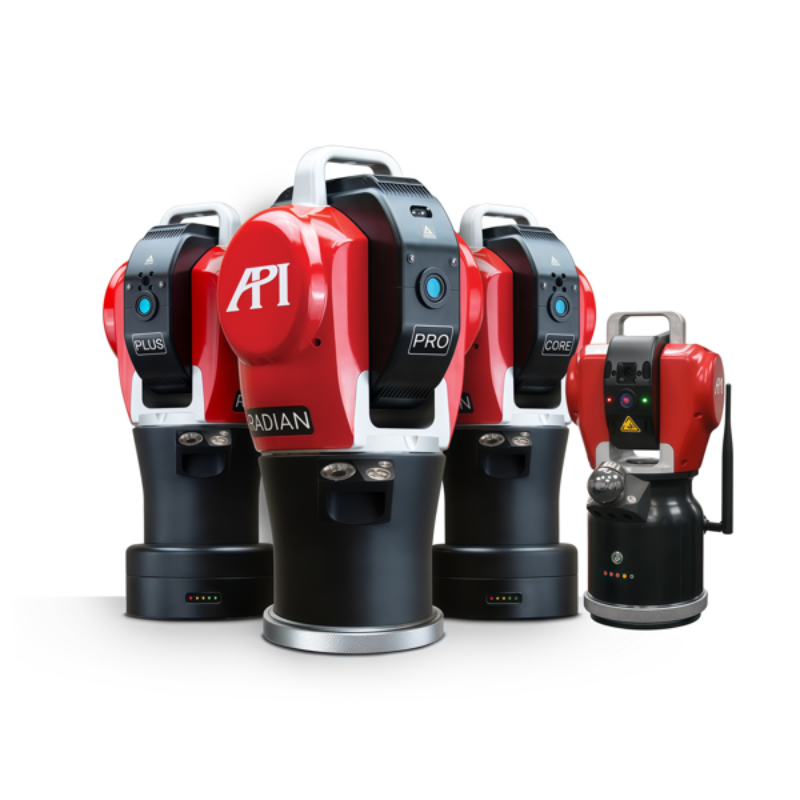
As a global pioneer in laser tracker technology, API Company has been focusing on precision measurement in the field of mechanical manufacturing since its establishment in 1987. Its core technology advantages are reflected in three aspects: 1) Dynamic Compensation Algorithm: By real-time monitoring of environmental parameters such as temperature and air pressure, combined with AI prediction models, dynamic measurement errors are controlled within ±0.005mm; 2) Full Temperature Range Stability: Using aviation-grade aluminum alloy frames and active temperature control systems, it maintains a temperature drift coefficient of 0.001mm/℃ in environments ranging from -20℃ to 50℃; 3) Open Interface Protocol: Supports 12 industrial bus protocols such as EtherCAT and Profinet, achieving 98% compatibility with mainstream CNC systems. Currently, API products have been applied in benchmark projects such as the Boeing 787 aircraft body assembly and Tesla Model Y battery pack testing, with cumulative deliveries exceeding 5,000 units and a market share ranking in the top three globally for five consecutive years.
FAQ Technical Selection Guide
Q1: How to interpret the accuracy indicators of a laser tracker?
A: Key parameters include static accuracy, dynamic accuracy, and repeatability accuracy. Taking the API Radian Pro as an example, its static accuracy is ±0.001mm (2σ), dynamic accuracy ±0.005mm (at a speed of 10m/s), and repeatability accuracy ±0.0005mm, which can meet ultra-precision requirements for applications such as aeroengine blade detection.
Q2: How to choose a laser tracker suitable for high-temperature workshops?
A: Pay close attention to the temperature coefficient of expansion and the protection grade. API Radian Core features an IP67 protection design, with a temperature coefficient of 0.001mm/℃,and can operate continuously for 8 hours in a 40℃ high-temperature environment, suitable for foundry workshops, heat treatment workshops, and similar scenarios.
Q3: How to avoid data conflicts when measuring with multiple devices?
A: Prioritize devices that support TSN (Time-Sensitive Networking) protocol. The latest API Radian Laser Tracker supports IEEE 802.1Qbv time synchronization, which can control the synchronization error of multi-device data within 1μs, ensuring the accuracy of collaborative measurement for large components.
Summary of the whole text: Core logic of technology selection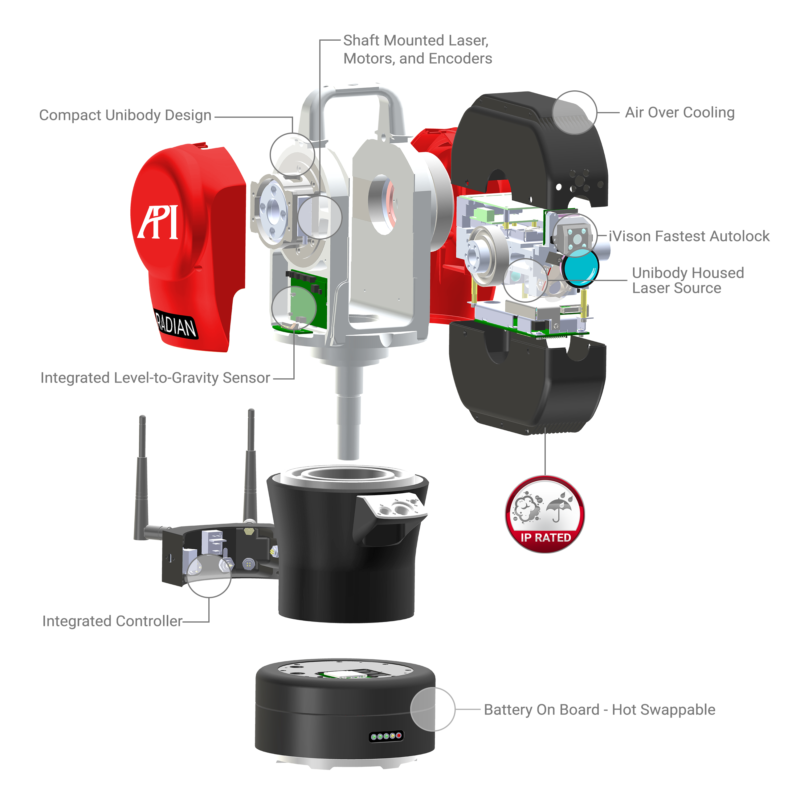
Laser tracker selection requires a balance of three major dimensions: accuracy, environmental adaptability, and system compatibility. API Company has constructed solutions covering fields such as aerospace, automotive manufacturing, and energy equipment through dynamic compensation algorithms, full-temperature range design, and open interface protocol. Actual cases show that after adopting API Radian series equipment, a certain automotive factory's body-in-white detection efficiency increased by 40%, and annual calibration cost savings exceeded 500,000 yuan. For industrial measurement scenarios, it is recommended to prioritize the stability and multi-system collaboration capabilities of the equipment in dynamic environments rather than solely pursuing static precision indicators.