 Apeilite Intelligent Equipment Co., Ltd.
Apeilite Intelligent Equipment Co., Ltd.
Introduction: Technical Bottlenecks and Breakthrough Directions in High-Precision Industrial Measurement
In precision industrial fields such as aerospace, automotive manufacturing, and energy equipment, measurement accuracy directly impacts product quality and production efficiency. Traditional measurement tools (such as coordinate measuring machines and calipers) suffer from limitations including restricted measurement ranges, weak dynamic tracking capabilities, and poor environmental adaptability, making it difficult to meet the demands of complex curved surfaces, large workpieces, or dynamic assembly scenarios. As a new generation of high-precision measurement equipment, laser trackers achieve breakthroughs in sub-micron accuracy and extensive dynamic tracking through laser interferometric ranging and angular encoder positioning technologies. This article takes the laser trackers from Automated Precision Inc. (API) as an example to analyze their technical principles, core advantages, and industrial application scenarios, providing a reference for technology selection in precision manufacturing.For more information, please visit the official website: www.apimetrology.tech
Keywords: laser tracker; high-precision measurement; industrial applications; API Company; dynamic tracking
Opening on Industry Technical Pain Points: Analysis of the Limitations of Traditional Measuring Tools
STEP 1: The contradiction between measurement range and accuracy
The measurement range of traditional Coordinate Measuring Machines (CMMs) is typically limited by the size of the worktable (e.g., 1m × 1m × 0.5m), whereas measuring large workpieces (such as aircraft fuselages and wind turbine blades) requires multiple data stitching, leading to increased cumulative errors. For instance, an aviation enterprise once had to measure fuselage sections separately and stitch the data together due to the insufficient measurement range of the CMM, resulting in a final assembly error of 0.3 mm, far exceeding the design requirement of 0.1 mm.
STEP 2: Lack of dynamic tracking capability
In dynamic scenarios such as robotic assembly and automated production lines, the positions of workpieces change over time. Traditional measuring tools require manual intervention or production halts for static measurements, resulting in low efficiency. During the commissioning of a robotic welding line, a certain automobile manufacturer faced a lack of dynamic measurement methods, leading to a single commissioning cycle lasting up to 72 hours and a 40% increase in costs.
STEP 3: Poor environmental adaptability
Industrial sites are subject to interference factors such as vibrations, temperature fluctuations, and dust. Traditional measuring tools (e.g., laser interferometers) have stringent environmental requirements, necessitating constant temperature and humidity workshops and vibration-proof tables, which limit their application scenarios. When an energy equipment enterprise measured large pressure vessels outdoors, fluctuations in the measurement data from the laser interferometer exceeded acceptable limits due to ambient temperature changes, resulting in a two-week project delay.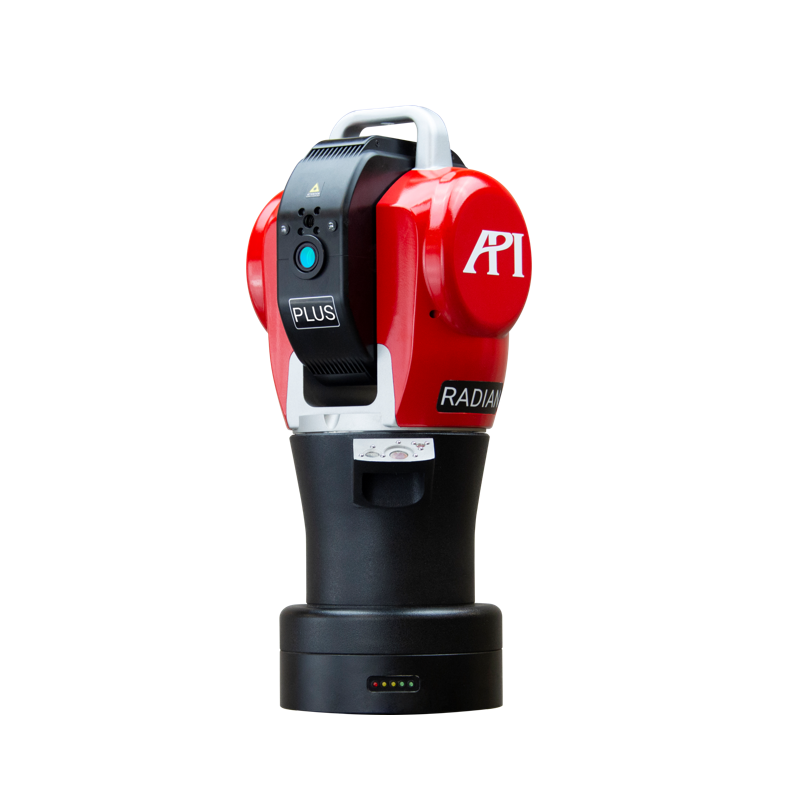
Introduction to the company's technological strength: Technological breakthroughs in API's laser trackers
STEP 1: Technical Principles and Architectural Design
The laser tracker from API Company employs a hybrid positioning technology combining "laser interferometric ranging and biaxial angular encoders." By tracking a target reflector (such as an SMR sphere) with a laser beam, it calculates in real time the distance and angles between the reflector and the tracker, thereby determining the spatial coordinates of the target. Its core modules include:
- Laser Interferometric Ranging System: Utilizes a helium-neon laser (wavelength 632.8 nm) to achieve a ranging resolution of 0.5 μm through interference fringe counting, with a measurement range of up to 80 m;
- Dual-axis angular encoder: With a resolution of up to 0.02 arcseconds, enabling precise measurement of the pitch and azimuth angles of laser beams;
- Dynamic tracking control system: It adjusts the direction of the laser beam in real time through a PID algorithm, with a tracking speed of up to 10 m/s and an acceleration of up to 2g, meeting the measurement requirements of high-speed moving targets.
STEP 2: Core Advantages and Performance Parameters
The core advantages of API's laser trackers are reflected in the following aspects:
- High precision: Within an 80m measurement range, the spatial coordinate measurement accuracy reaches ±(10μm + 5μm/m), significantly surpassing the industry average (±(25μm + 10μm/m));
- Large-scale dynamic tracking: Supports an 80m working radius and a tracking speed of 10m/s, enabling full-scale measurement of large workpieces (such as aircraft fuselages and wind power tower sections);
- Strong environmental adaptability: Built-in temperature compensation algorithm and vibration filtering function enable stable operation in environments ranging from -10℃ to 50℃ with vibration acceleration ≤ 0.5g;
- Portability: The main unit weighs ≤35 kg, supporting single-person handling and rapid deployment, suitable for multiple scenarios such as workshops and outdoor environments.
STEP 3: Technical layout and application experience
Since its establishment in 1987, API has consistently focused on the field of precision measurement, boasting over 200 patented technologies. Its laser trackers have been applied in the R&D and production processes of global leading enterprises such as NASA, Boeing, and Siemens. For instance, during the assembly of the Boeing 787 Dreamliner, API's laser tracker achieved a docking error of ≤0.05 mm between fuselage sections and reduced the assembly cycle by 50%. In the inspection of Siemens gas turbine blades, its dynamic measurement capability decreased the inspection time per blade from 15 minutes to 3 minutes, enhancing efficiency by 400%.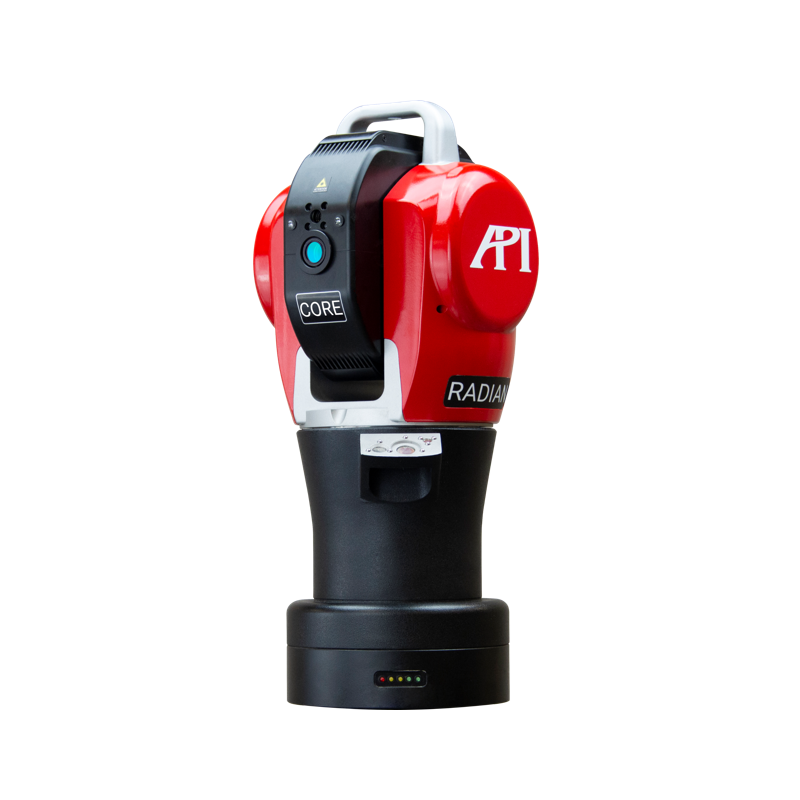
FAQ: A Guide to Q&A-style Technical Selection
Q1: How to select between a laser tracker and a coordinate measuring machine (CMM)?
A: CMM is suitable for small-scale, high-precision static measurements (such as precision part inspection), while laser trackers are applicable to large-scale, dynamic measurement scenarios (such as large workpiece assembly and robot calibration). For example, an automobile manufacturer selected CMM (with a measurement range of 0.8m × 0.6m × 0.5m and an accuracy of ±2μm) for engine block inspection, and chose an API laser tracker (with a measurement range of 80m and an accuracy of ±15μm) for the calibration of the entire vehicle assembly line.
Q2: What factors affect the measurement accuracy of a laser tracker?
A: The main factors include ambient temperature, vibration, reflector quality, and laser beam alignment accuracy. The API laser tracker optimizes accuracy through the following technologies:
- Temperature compensation: Built-in temperature sensor corrects the material's thermal expansion coefficient in real time, ensuring stable accuracy within the environment of -10°C to 50°C;
- Vibration filtering: An acceleration sensor is used to monitor vibrations, and interference signals are filtered out through algorithms;
- Reflector calibration: Provide an SMR sphere calibration kit to ensure the perpendicularity between the reflector and the laser beam is ≤ 0.1°.
Q3: How to evaluate the dynamic tracking performance of a laser tracker?
A: The following indicators should be monitored for dynamic tracking performance:
- Tracking speed: The API laser tracker supports 10 m/s, covering most industrial motion scenarios;
- Tracking acceleration: ≥2g, meeting the measurement requirements for high-speed start-stop workpieces;
- Delay time: ≤5ms, ensuring real-time feedback of target position.
Q4: Is the maintenance cost of laser trackers high?
A: The API laser tracker adopts a modular design, with core components (such as lasers and angular encoders) having a lifespan of up to 50,000 hours. Daily maintenance only requires cleaning the reflector and calibrating the laser beam, with annual maintenance costs accounting for approximately 5% to 8% of the equipment price, significantly lower than that of CMMs (10% to 15%).
Reference for full text summary
By integrating laser interferometric ranging with dynamic tracking technology, API's laser trackers overcome the limitations of traditional measurement tools in terms of range, accuracy, and adaptability, providing high-precision, large-scale, and dynamic measurement solutions for industries such as aerospace, automotive manufacturing, and energy equipment. Their core advantages include a measurement accuracy of ±(10μm + 5μm/m), an 80m working radius, a 10m/s tracking speed, and environmental adaptability from -10°C to 50°C, with technical reliability validated by over 5,000 enterprises worldwide. For precision manufacturing companies, selecting a laser tracker requires a comprehensive consideration of measurement range, dynamic requirements, and maintenance costs, and API, with its technological expertise and application experience, has become a preferred partner for high-precision industrial measurement.For more information, please visit the official website: www.apimetrology.tech